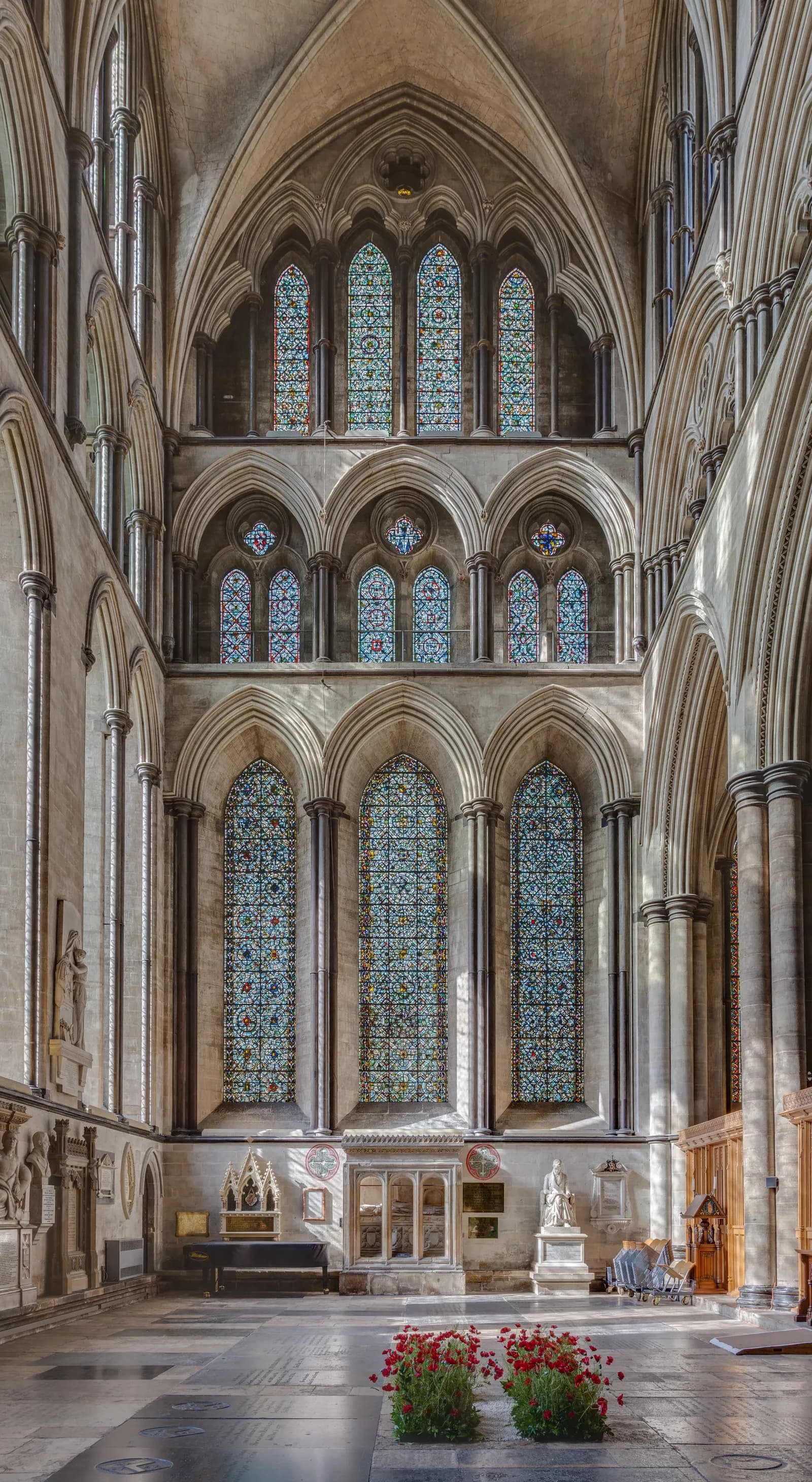
In April 1220, Bishop Richard Poore laid the foundation stones for a new cathedral on water meadows beside the River Avon, two miles south of the windswept hillfort at Old Sarum. The act marked the culmination of a decades-long effort to relocate the cathedral away from its cramped and contentious garrison setting, and it established the grid-patterned city that still forms the core of modern Salisbury.
Conflict at Old Sarum
The original cathedral at Old Sarum stood within the ramparts of an Iron Age hillfort roughly two miles north of the present city, sharing the exposed plateau with a royal castle and its garrison. By the late twelfth century, relations between the clergy and the military had deteriorated; in 1197, Bishop Herbert Poore, Richard's elder brother, sought permission to move the cathedral to a more suitable location. The garrison town offered limited space for the cathedral community, and sources indicate that friction with the castle authorities contributed to the clergy's desire to leave.
The Vision for a New City
Richard Poore, who had studied under Stephen Langton in Paris and served as Dean of Salisbury from 1197, succeeded his brother as bishop by 27 June 1217. He laid out the new town in 1219 with a gridiron street plan intended to give the cathedral's builders and future inhabitants more room than the cramped settlement at Old Sarum. The chosen site lay on water meadows beside the River Avon, where the high water table meant the cathedral foundations could be sunk only four feet deep. The resulting cathedral close, which the architectural historian Nikolaus Pevsner later called "the most beautiful of England's closes," remains the largest in Britain.
The Foundation and Construction
On 28 April 1220, foundation stones were laid for the new cathedral, marking the formal birth of the riverside settlement. Funds came principally from donations by canons and vicars throughout south-east England, who pledged fixed annual contributions. Elias of Dereham, a Salisbury canon who had been present at Runnymede in 1215, oversaw the construction. The nave, transepts, and choir were finished by 1258; the cloisters were added in 1240 and the chapter house in 1263.
A Lasting Legacy
Poore's tenure in Salisbury was brief; he was translated to the see of Durham on 14 May 1228, little more than eight years after the foundation ceremony. Yet the city he planned continued to grow within its original grid, and the cathedral he founded now rises 404 feet above the meadows, its spire the tallest in England. The building holds one of the four surviving original copies of Magna Carta; Elias of Dereham, who oversaw the cathedral's construction, had been present at Runnymede in 1215 and was involved in distributing some of the charter's original copies. A sculpture of Bishop Poore holding a model of the cathedral stands on the west front, facing the close he created.